
Belgrade Fair

For a long time, the issue of building a fair that would suit Belgrade as the capital of Yugoslavia and the main economic and administrative center of the country has been raised. Although a special association was founded in 1923 with the aim of improving all branches of the economy, in which the organization of fairs was supposed to be of primary importance, only during the first half of the 1930s did more concrete activities take place on the realization of this idea.
Ossuary on the island of Vido

The island of Vido in the Ionian Sea, near the Greek island of Corfu, has a special significance in the recent history of the Serbian people, because it housed a hospital for Serbian soldiers who came to Corfu after crossing Albania during the winter of 1915/1916. year. The most seriously wounded and sick who fell ill on the way to the Greek island of salvation were disemabarked on the island of Vido.
Rental office building of the Mortgage Bank of the Trade Fund, Palace “Albania” (H.B.T.)
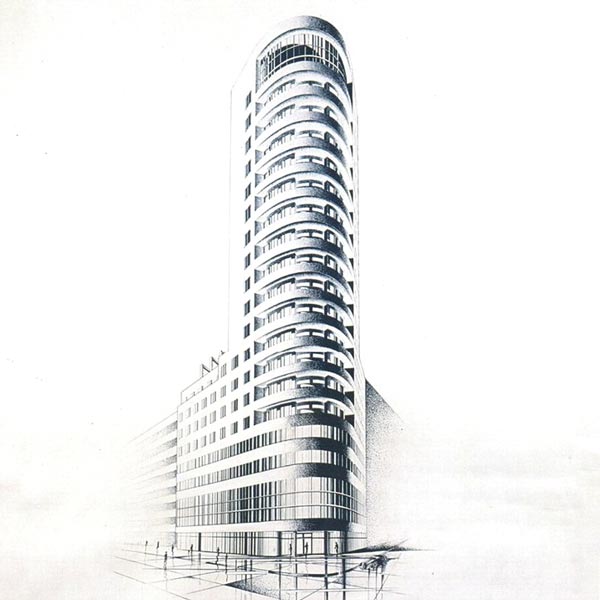
After the demolition of the Albania tavern, located on the corner of Kolarčeva and Knez Mihajlova streets, a well-known meeting place for many Belgraders, which they called a mockery and unhygienic place in the city center, the question arose as to what should be built in that important location in the capital.
Workers’ settlement of Kvarner shipyards

The dominance of social ideas and active advocacy for the rights and position of workers in the new socio-political order after the Second World War, around the world and in the new socialist Yugoslavia, is dominated by aspirations to provide workers with housing worthy of their merits in the renewal and upbuilding of the state.
Housing for clerks in industrial enterprises

The competition work for the residential building for clerks of industrial enterprises in Belgrade, of which two drawings have been preserved, represents an unknown Zloković design from the post-war period of creativity, which is now available to researchers in the Milan Zloković Collection at the Belgrade City Museum.
Gynecology and Obstetrics Clinic of the Faculty of Medicine

Zloković’s post-war work, left in the shadow of his pioneering achievements of mature modernism, left a unique architectural trace in Serbian architecture of the second half of the 20th century, in which multilayered design experiences were sublimated and continuous research work aimed at understanding and permeating scientific and artistic components of architecture.